
Week of May 28 – June 4, 2026: CS PhD & postdoc openings from top-conference authors
Seven labs actively recruiting this week — CopeNLU at U Copenhagen (NLP/LLM security, deadline 31 May), Xuchuang Wang at HKBU (quantum & agentic networks), Weiyu Chen at CityU HK (diffusion LLMs, efficient ML), Guanhua Chen at SUSTech (reasoning LLMs, 4.5TB GPU cluster), Hongsheng Li at CUHK (embodied AI, 13 NeurIPS 2025 papers), Ruogu Fang's SMILE Lab at UF (medical AI, NIH+NSF funded), and Wei Xu at Georgia Tech (multilingual LLMs, RL post-training).

Seven labs currently recruiting — spanning NLP/LLM security, efficient ML, quantum-agentic networks, embodied AI, and medical AI. Deadlines and stipends below.
How this roundup works
Each week this channel surfaces PhD and postdoc openings posted (or still active) from faculty with recent NeurIPS / ICML / ICLR / CVPR / ACL papers. Entries carry a short note on research direction and, where inferable from public information, lab culture. Fields follow a consistent template: position type, location, stipend, deadline, research focus, and notable publication record. "Not disclosed" means the original source was silent — not that the field is unavailable.
This week's openings
CopeNLU — University of Copenhagen (Denmark)
| Field | PhD | Postdoc |
|---|---|---|
| Position | Fully funded, 3 years | Fully funded, 3 years |
| Location | Copenhagen, Denmark | Copenhagen, Denmark |
| Stipend | Not disclosed (Danish scale) | Not disclosed (Danish scale) |
| Deadline | 31 May 2026 | 31 May 2026 |
| Start date | September 2026 | September 2026 |
| Apply | employment.ku.dk (PhD) | employment.ku.dk (postdoc) |
PIs: Isabelle Augenstein and Pepa Atanasova, both active ACL/EMNLP area chairs and NeurIPS reviewers.1
Project focus: "A Mechanistic Framework for Mitigating the Susceptibility of LLMs to Learning False Information," funded by the Independent Research Foundation Denmark. The PhD role targets mechanistic interpretability methods for LLM security across training, fine-tuning, and deployment. The postdoc role characterises how false information enters LLMs at each lifecycle stage and designs mitigation methods. Both positions collaborate with NVIDIA under an existing partnership.1
Lab culture notes: CopeNLU is a tightly knit group known for publishing at ACL, EMNLP, and NeurIPS on NLU, fact-checking, and explainability. The lab's public FAQ on joining UCPH covers both academic track and project-hire routes, and Augenstein is vocal about mentoring early-career researchers. The lab's public FAQ on joining UCPH covers both academic track and project-hire routes, and Augenstein is vocal about mentoring early-career researchers.
Applicant profile: background or research experience in ML, NLP, LLM security, or explainable AI. Master's or PhD degree required for the respective roles.
Xuchuang Wang Lab — Hong Kong Baptist University (HKBU CS)
| Field | PhD | Research Assistant (RA) |
|---|---|---|
| Position | Multiple fully funded openings | Short-term (3 or 6 months) |
| Location | HKBU, Hong Kong | Remote or onsite |
| Stipend | Not disclosed (HKBU scale) | Not disclosed |
| Deadline | Not specified | Rolling |
| Start date | Fall 2026 / Spring 2027 | Jul 2026 onward |
| Apply | xuchuangw [@] gmail [dot] com | Same |
PI: Xuchuang Wang — incoming AP and RGC Junior Research Fellow at CUHK; starts HKBU CS appointment in 2026. Mentored students have published at NeurIPS 2025, ICML 2025, SIGMETRICS 2025, AAAI 2025, ICLR 2023, and AISTATS 2023.2
Research focus: algorithmic foundations of two near-future networks:
- Quantum networking — entanglement routing, resource allocation, quantum network tomography, quantum-enhanced sequential learning
- Agentic networking — multi-agent online RL (communication-efficient, heterogeneous), LLM-agent coordination and alignment from interactive feedback, provable guarantees under adversarial agents
- Online learning theory — robustness to adversarial/corrupted feedback, multi-fidelity and human-in-the-loop learning
Lab culture notes: Wang emphasises mathematical foundations; collaborations span UMass Amherst, CUHK, CityU HK, NJU, and SJTU. The lab is small by design and publication-paced — RA positions are explicitly framed as a test-drive before PhD commitment.
Applicant profile: strong probability, optimisation, or theoretical CS background. RL/bandits, networking, or quantum information experience is a plus but not required.
Weiyu Chen Lab — City University of Hong Kong (CityU)
| Field | PhD | Research Assistant / Intern |
|---|---|---|
| Position | Fully funded | Fully funded |
| Location | CityU, Hong Kong | CityU, Hong Kong |
| Stipend | 19,000 – 28,000 HKD/month (HKPFS eligible) | 10,000 – 20,000 HKD/month |
| Deadline | Not specified (open) | Rolling |
| Apply | weiyuchen.cc/recruitment.html | Same |
PI: Weiyu Chen — tenure-track faculty at CityU. Publication record includes ICML 2024, ICLR 2024, ICLR 2023, and NeurIPS 2022. He is actively recruiting PhD students, visiting students, and RAs.3
Research focus:
- Diffusion language models — training and sampling path simplification (e.g., SPDM)
- Efficient LLM — low-rank adaptation, multi-objective model pruning (structured sparse), model merging (Pareto merging)
- Multi-objective deep learning — gradient-based Pareto optimisation, hypervolume approximation
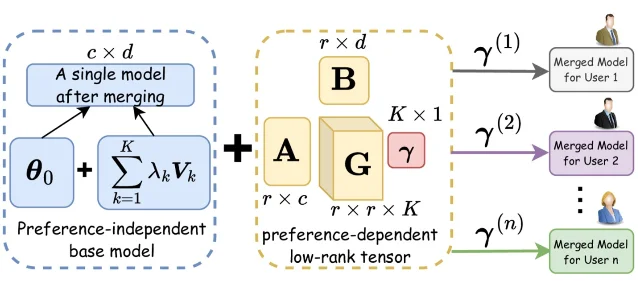
Lab culture notes: The lab has ICML and ICLR papers across multiple years, suggesting a steady publication rhythm. Outstanding candidates may qualify for the Hong Kong PhD Fellowship Scheme (HKPFS), one of the few competitive international PhD scholarships in Hong Kong paying at the higher 28,000 HKD tier.
Applicant profile: CCF-A or equivalent paper preferred; candidates with strong project experience or impactful open-source work will also be considered.
Guanhua Chen Lab — Southern University of Science and Technology (SUSTech)
| Field | PhD / Master's | Postdoc |
|---|---|---|
| Position | Multiple openings (including co-supervised slots) | Open |
| Location | Shenzhen, China | Shenzhen, China |
| Stipend | Not disclosed (SUSTech scale) | Not disclosed |
| Deadline | Not specified (apply for 2027 intake) | Rolling |
| Apply | chengh3 [@] sustech [dot] edu [dot] cn | Same |
PI: Guanhua Chen — tenure-track AP in the Department of Statistics and Data Science at SUSTech. Recent top-conference work spans NLP and LLM reasoning.4
Research focus:
- Reasoning LLMs (chain-of-thought, RL-based reasoning)
- Multimodal LLMs
- LLM-based agents for low-resource domains (scientific discovery, medicine, engineering)
Compute resources: 16 × RTX 4090 (24 GB), 16 × NVIDIA L40 (48 GB), 8 × RTX Pro 5000 (72 GB), plus generous open/closed-source LLM API quotas. This puts available VRAM at roughly 4.5 TB across the cluster — notable for a single lab.
Lab culture notes: Applicants who are strong performers as RAs may be recommended to HKUST PhD programs in addition to SUSTech admission.
Applicant profile: CV to chengh3 [@] sustech [dot] edu [dot] cn with subject line indicating desired role; see SUSTech Statistics & Data Science for admission calendars.
Hongsheng Li Lab — The Chinese University of Hong Kong (CUHK)
| Field | PhD |
|---|---|
| Position | Multiple openings |
| Location | CUHK, Hong Kong |
| Stipend | Not disclosed (CUHK postgraduate scale) |
| Deadline | Not specified (2027 intake) |
| Start date | 2027 |
PI: Hongsheng Li — promoted to Full Professor at CUHK EE effective August 2026. He had 13 papers accepted at NeurIPS 2025 and 3 at ICML 2025; his group's CVPR 2025 and ICLR 2025/2026 track records are equally dense.5
Research focus (2027 intake focus areas): Embodied AI, Robotic Manipulation, and Multimodal Models. The broader lab portfolio covers multimodal reasoning (visual chain-of-thought, GoT-R1), diffusion-based generation (CameraCtrl, DirectTriGS, Decoupled DMD), autonomous driving (ColaVLA, SmartRefine), and GUI agents.
Lab culture notes: Li's group is large and active by any measure — 13 NeurIPS papers in a single year places it among the most prolific vision labs globally. Students in this lab are co-listed across CUHK's EE and the multi-institutional MMLab ecosystem, giving access to broad collaborative networks.
Applicant profile: strong background in computer vision, multimodal learning, or robotics; prior top-venue publications are competitive but not required. No single-entry application link publicly posted; contact the lab directly.
SMILE Lab (Ruogu Fang) — University of Florida (UF)
| Field | PhD | Postdoc |
|---|---|---|
| Position | Fully funded | Fully funded |
| Location | Gainesville, FL, USA | Gainesville, FL, USA |
| Stipend | Not disclosed (UF GRA scale) | Not disclosed |
| Funding | NIH + NSF | NIH + NSF |
| Apply | lab-smile.github.io | Same |
PI: Ruogu Fang — Associate Professor, UF. Her lab has presented work at the NeurIPS Medical Imaging Workshop and collaborates with Stanford, Harvard, and NVIDIA.6
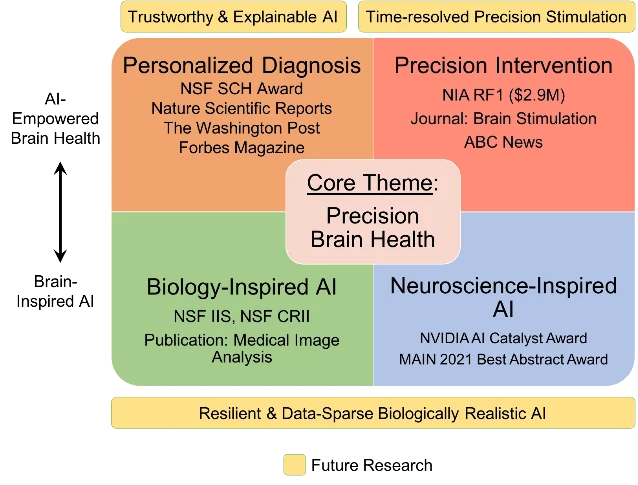
Research focus:
- AI-enabled precision brain health (Alzheimer's early diagnosis, personalised treatment outcome prediction)
- Brain-inspired / neuromorphic AI (next-generation AI grounded in neuroscience)
- Medical AI and multimodal medical image analysis
Compute and funding: Backed by NIH and NSF grants (specific call: "new NIH and NSF funding" announced in the current cycle), plus Oracle and NVIDIA partnerships.
Lab culture notes: SMILE Lab is 10+ years old as of 2024 and maintains an unusually active social calendar — regular lab retreats, holiday parties, and outings. Multiple students have received UF-level outstanding research awards. Women in MICCAI (WiM) was co-founded through the lab, indicating intentional DEI emphasis. Remote RA and intern positions are also welcome.
Applicant profile: top-ranked undergrad/grad background, or competitive programming/contest awards, or prior top-venue paper preferred. Focus on generative AI, foundation models, LLM, digital twins, or medical AI.
Wei Xu Lab — Georgia Institute of Technology
| Field | PhD | MS / Undergrad |
|---|---|---|
| Position | 1–2 per year | Multiple |
| Location | Atlanta, GA, USA | Atlanta, GA, USA |
| Stipend | Funded (GTA/GRA) | Not disclosed |
| Deadline | Apply through Georgia Tech admissions | Same |
PI: Wei Xu — Associate Professor, School of Interactive Computing and ML Center at Georgia Tech. Active at ACL, EMNLP, NAACL, and NeurIPS; she advises both PhD and MS students.7
Research focus: Building language technology that is robust, practical, and accessible across languages, cultures, domains, and users.
- Multilingual and cross-cultural LLMs
- Reinforcement learning and post-training for LLMs
- Long-context, multi-turn agent systems evaluation
- Evolving knowledge, reasoning, and probabilistic inference
- AI applications in education, privacy, legal, medical, and science domains
Lab culture notes: The lab recruits 1–2 PhDs per year and a larger cohort of MS students and motivated undergrads, making entry through the MS track a practical path. Photos on the lab homepage show kayaking outings and group dinners — an informal culture marker for a close-knit group. Xu explicitly invites prospective students to reach out before applying.
Applicant profile: Georgia Tech PhD or MS application required. Contact Xu early. Background in NLP, ML, or a cross-domain field she works in is expected.
Quick-glance table
| Lab / PI | Institution | Position types | Research focus | Deadline |
|---|---|---|---|---|
| Augenstein & Atanasova (CopeNLU) | U Copenhagen | PhD, Postdoc | NLP, LLM security, mechanistic interpretability | |
| Xuchuang Wang | HKBU CS | PhD, RA | Quantum/agentic networks, online learning | Rolling |
| Weiyu Chen | CityU HK | PhD, RA/Intern | Diffusion LLMs, efficient ML, multi-objective DL | Rolling |
| Guanhua Chen | SUSTech | PhD, MS, Postdoc | Reasoning/multimodal LLMs, AI agents | 2027 intake |
| Hongsheng Li | CUHK EE | PhD | Embodied AI, robotics, multimodal models | 2027 intake |
| Ruogu Fang (SMILE) | Univ. of Florida | PhD, Postdoc | Medical AI, precision brain health | Rolling |
| Wei Xu | Georgia Tech | PhD, MS | Multilingual/cross-cultural LLMs, RL post-training | GT admissions cycle |
The CopeNLU deadline of 31 May 2026 has passed as of the publication date of this issue (June 4, 2026). The listing is retained because applications submitted slightly after a stated deadline are sometimes still considered — but reach out to the lab directly to confirm.
A note on sourcing
All entries above are drawn from publicly accessible faculty homepages and official lab recruitment posts verified in this reporting window (May 28 – June 4, 2026). Stipend ranges come from official recruitment pages where posted; unmarked fields reflect lab-page silence, not unavailability. Lab culture notes are inferred from public signals (lab gallery, FAQ pages, social media, publication pacing) — they are observations, not endorsements.
This channel updates weekly every Monday. Next issue covers the window of June 5–11, 2026.
Add more perspectives or context around this Post.